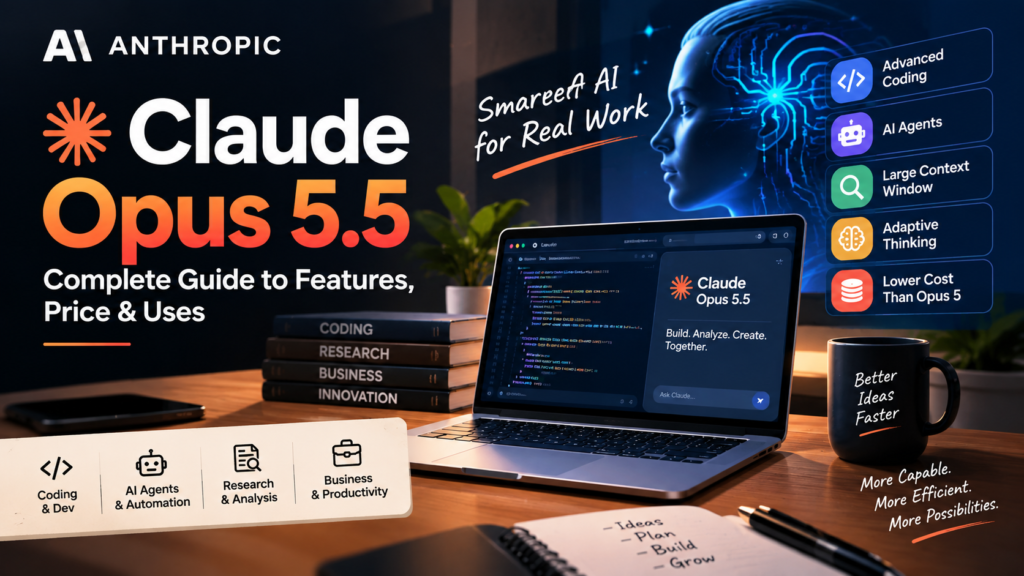
Artificial intelligence is changing faster than ever, and every few weeks we are seeing new AI models designed to handle more complicated tasks. One of the latest developments is Claude Opus 5.5 from Anthropic.
Claude Opus 5.5 is designed for demanding tasks such as coding, research, AI agents and professional knowledge work. Instead of being used only as a chatbot that answers questions, the model is built to handle longer and more complex workflows.
For developers, businesses and AI enthusiasts, this raises an important question: what exactly can Claude Opus 5.5 do, how much does it cost, and what makes it different from previous Claude models?
Let’s understand Claude Opus 5.5 in simple language.
Table of Contents
What Is Claude Opus 5.5?
Claude Opus 5.5 is a high-end artificial intelligence model developed by Anthropic.
Anthropic is the company behind the Claude family of AI assistants. The Claude lineup includes different models designed for different combinations of speed, intelligence and cost.
The Opus series is aimed at more demanding workloads.
Claude Opus 5.5 is positioned toward users who need AI for complex coding, long-running tasks, research, professional work and AI-agent workflows.
The biggest idea behind this model is that AI is moving beyond simple question-and-answer conversations.
Instead of asking an AI:
“Write a small piece of code.”
Users can increasingly ask:
“Analyse this project, find the problems, make the required changes, test the result and explain what you changed.”
That type of workflow requires considerably more planning and reasoning.
This is where models such as Claude Opus 5.5 are designed to be useful.
Why Is Claude Opus 5.5 Important?
The AI industry has become extremely competitive.
OpenAI, Google, Anthropic and other companies are continuously improving their models. At the same time, businesses are looking for AI systems that are not only capable but also affordable enough to use regularly.
A very powerful model can be difficult for businesses to deploy if every task becomes expensive.
Anthropic has therefore focused on both capability and efficiency with Claude Opus 5.5.
The company says the model is designed for demanding coding and professional knowledge work while offering lower API pricing than the previous Opus generation.
That combination is important because businesses are increasingly experimenting with AI agents and automated workflows.
Claude Opus 5.5 Features
Advanced Coding
Coding is one of the biggest areas where Claude Opus 5.5 is expected to be useful.
Modern software projects can contain thousands or even millions of lines of code. Understanding such projects requires more than generating a single function.
An advanced AI coding model needs to understand the relationship between files, identify problems, make changes and check whether those changes actually work.
Claude Opus 5.5 is designed for this kind of work.
Developers can potentially use it for:
- Debugging software
- Writing new code
- Refactoring existing code
- Reviewing code
- Creating tests
- Explaining technical problems
- Updating documentation
- Working across multiple files
- Understanding large codebases
This represents an important change in AI coding.
The focus is gradually moving from AI as a simple code generator toward AI as a development assistant that can participate in larger projects.
However, developers should still review AI-generated code.
Even highly capable AI models can make mistakes, introduce bugs or misunderstand a project’s requirements.
AI Agent Capabilities
Another major area associated with Claude Opus 5.5 is AI agents.
A normal chatbot generally follows a simple pattern.
You ask a question.
The AI produces an answer.
An AI agent can work differently.
An agent can potentially break a large objective into smaller steps, use tools, inspect information, make changes and continue working toward the final goal.
For example, imagine a developer has a software project with a difficult bug.
Instead of asking:
“Why is this error happening?”
The developer could eventually ask an AI agent to:
- Inspect the project.
- Identify the possible cause.
- Examine related files.
- Suggest a solution.
- Make the required changes.
- Run tests.
- Report the result.
This is much closer to having an AI assistant participate in a workflow.
Claude Opus 5.5 has been positioned for this kind of longer-running agentic work.
For businesses, AI agents could potentially help with research, documentation, analysis, software maintenance and other repetitive workflows.
But giving an AI agent more control also increases the importance of permissions, monitoring and human review.
Large Context Window
One of the most interesting capabilities of advanced AI models is their ability to process large amounts of information.
Claude Opus 5.5 supports a very large context window through the API.
Anthropic’s documentation lists a context window of up to 1 million tokens for Opus 5.5.
Why does that matter?
Imagine you are working on a large software project.
Instead of giving an AI one small file at a time, a large context window allows the model to work with much more project information in the same task.
The same concept can be useful for long documents.
For example, a researcher could work with:
- Research papers
- Reports
- Documentation
- Large datasets
- Technical material
- Multiple project files
A large context window does not automatically mean that the AI will understand everything perfectly.
The quality of the result still depends on the information provided, the instructions and the model’s ability to reason about that information.
But having more context can make complex workflows much easier.
Adaptive Thinking
Another important concept is adaptive thinking.
Not every question requires the same amount of reasoning.
If you ask an AI:
“What is 10 plus 10?”
There is no reason to spend a huge amount of computing power on the answer.
But if you ask:
“Analyse this large software architecture and identify possible security problems.”
The task is much more complicated.
Adaptive reasoning allows AI systems to devote more effort to difficult problems.
This is particularly useful for coding, research and multi-step tasks where the model needs to think through several possibilities before producing a final answer.
For users, this can mean better performance on complicated requests without treating every simple question as a major reasoning problem.
Claude Opus 5.5 Pricing
Pricing is another important part of any AI model.
Anthropic lists Claude Opus 5.5 API pricing at:
- $4 per million input tokens
- $20 per million output tokens
The previous Opus generation was priced higher.
This is particularly relevant for companies and developers using AI through APIs.
Imagine a company processing millions of tokens every day.
Even a relatively small reduction in the price per million tokens can become meaningful at a large scale.
However, API pricing should not be confused with consumer subscription pricing.
The amount an individual user pays can depend on the product, subscription, platform and usage.
Therefore, anyone planning to use Claude Opus 5.5 should check the current pricing for the specific service they intend to use.
Who Can Use Claude Opus 5.5?
Claude models can be accessed through Anthropic’s ecosystem and, depending on availability, through cloud platforms and developer services.
Developers and businesses can use APIs to integrate AI capabilities into their own applications.
Cloud platforms can also provide access to Claude models.
This can be useful for companies that already have infrastructure on services such as Amazon Web Services or other cloud providers.
For example, a company building an internal AI assistant could potentially connect an advanced Claude model to its existing software systems.
The exact availability and pricing can vary by platform.
Claude Opus 5.5 for Developers
Developers are one of the most obvious groups that could benefit from a high-end model like Claude Opus 5.5.
Software development involves many tasks that require understanding context.
A developer may need to understand an unfamiliar codebase, find a bug, update an old component or migrate software to a newer technology.
AI can help with many of these tasks.
For example, a developer could use Claude to explain an unfamiliar section of code before making changes.
The model could also help create unit tests, review code or suggest possible improvements.
The important thing is that AI should work as part of the development process rather than replacing testing and human judgement.
Code that looks correct can still contain serious problems.
Claude Opus 5.5 for Businesses
Businesses are also experimenting with AI for tasks beyond content writing.
Companies can use AI for research, internal documentation, customer-support workflows, data analysis and automation.
A powerful model can potentially help employees process large amounts of information faster.
For example, a business could use AI to summarise long internal documents or organise information from multiple sources.
Another possibility is using an AI agent to perform repetitive software or research tasks.
The actual value depends on how well the AI is integrated into the company’s workflow.
Simply having access to a powerful AI model does not automatically make a business more efficient.
Good instructions, reliable data, appropriate permissions and human oversight are still important.
Claude Opus 5.5 for Research
Research is another area where large-context AI can be useful.
Researchers often work with large amounts of text.
They may need to compare documents, identify important information, organise notes or create summaries.
A model with a large context window can potentially process more material within a single workflow.
For example, a researcher could provide multiple technical documents and ask the model to identify common themes.
However, AI-generated research should always be verified.
An AI model can misunderstand information, miss important details or generate incorrect statements.
For academic or professional research, original sources should remain the final authority.
Claude Opus 5.5 and AI Safety
As AI systems become more capable, safety becomes increasingly important.
A model that can write code, interact with tools and complete longer workflows has more potential to create useful results.
But the same capabilities can also create risks if they are used incorrectly.
Anthropic has described safety testing and safeguards as part of the development of Claude Opus 5.5.
The company has also highlighted testing around areas such as cybersecurity and other high-risk capabilities.
Users should understand that safety systems reduce risk but cannot guarantee that an AI model will always behave perfectly.
AI models can still produce incorrect or unexpected outputs.
This is especially important when an AI system is given access to external tools or permission to make changes.
Claude Opus 5.5 vs Previous Claude Models
The biggest difference is not simply the model number.
The broader change is the direction of Claude toward longer-running and more complex tasks.
Claude Opus 5.5 focuses on areas such as:
- Advanced coding
- AI agents
- Large-context tasks
- Professional knowledge work
- Complex reasoning
- Multi-step workflows
- Lower API costs compared with the previous Opus generation
This makes the model particularly interesting for developers and businesses.
For a person who only needs quick answers or simple writing assistance, however, a high-end model may not always be necessary.
What Does Claude Opus 5.5 Mean for the Future of AI?
The release of Claude Opus 5.5 reflects a larger change happening across the AI industry.
Early AI assistants were mainly used for generating text.
Users asked a question and received an answer.
Modern AI systems are increasingly being designed to do more.
They can work with files, use tools, write code, analyze information and complete multiple steps.
The next stage could be AI systems that function more like digital workers.
Instead of asking an AI to help with one small task, users may eventually give it an objective and allow it to work through the necessary steps.
This could change software development, research, business operations and many other industries.
But it also creates new questions about security, privacy, reliability and human control.
The more responsibility given to an AI system, the more important it becomes to understand what the system is doing.
Is Claude Opus 5.5 Worth Using?
There is no single AI model that is perfect for every task.
Claude Opus 5.5 is aimed at demanding workloads.
If you only need simple answers, basic brainstorming or short writing tasks, you may not need the most advanced model available.
But if you work with large codebases, complex research, long documents or multi-step AI workflows, its capabilities can become much more relevant.
Before choosing an AI model, consider:
- What kind of tasks will you perform?
- How much information does the task involve?
- Do you need advanced coding?
- Do you need AI agents?
- How important is speed?
- What is your budget?
- Which tools and integrations do you already use?
The newest model is not automatically the right model for everyone.
The better approach is to match the model’s capabilities with the actual problem you are trying to solve.
Frequently Asked Questions
What is Claude Opus 5.5?
Claude Opus 5.5 is a high-end AI model developed by Anthropic. It is designed for advanced coding, AI agents, professional knowledge work and complex multi-step tasks.
When was Claude Opus 5.5 released?
Anthropic announced Claude Opus 5.5 in September 2026.
How much does Claude Opus 5.5 cost?
Anthropic lists API pricing at $4 per million input tokens and $20 per million output tokens. Actual costs can vary depending on the platform and usage.
Is Claude Opus 5.5 good for coding?
Coding is one of the major use cases for Claude Opus 5.5. It can help with debugging, code generation, refactoring, testing and understanding larger software projects.
Does Claude Opus 5.5 support AI agents?
Yes. Agentic and longer-running workflows are among the key areas associated with the model.
Does Claude Opus 5.5 have a large context window?
Yes. Anthropic’s API documentation lists support for a 1 million token context window.
Is Claude Opus 5.5 free?
Access depends on the product and platform. API usage is generally billed based on usage, while consumer access depends on the available Claude plan.
Final Thoughts
Claude Opus 5.5 represents another step toward more capable AI systems.
Its importance is not only about producing better text.
The bigger development is the move toward AI that can understand large amounts of information, work with code, use tools and participate in longer workflows.
For developers, this could mean more capable AI coding assistance.
For businesses, it could mean new opportunities for automation and research.
For everyday users, it shows how quickly AI assistants are evolving.
At the same time, powerful AI should be used carefully. Important information should be verified, AI-generated code should be tested and autonomous workflows should have appropriate human oversight.
The future of AI is increasingly moving from simple chatbots toward systems that can help complete real tasks.
Claude Opus 5.5 is one of the latest examples of that transition.
If you want to explore more AI tools, check out our AI Tools section for practical guides and tutorials on the latest AI software.


[…] If you want to know about Anthropic’s other models, read our guide to Claude Opus 5.5: features, price and uses. […]