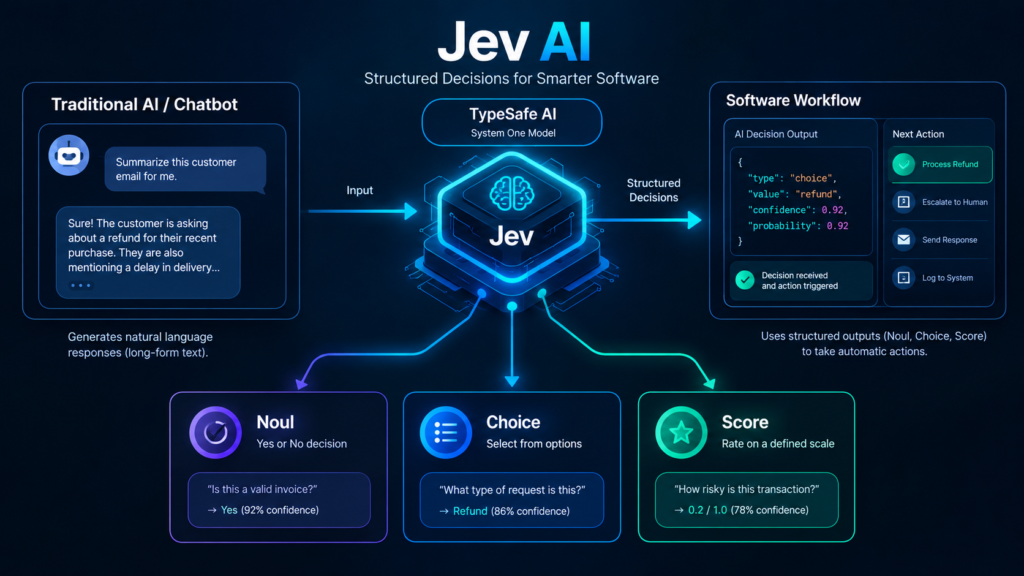
Artificial intelligence has mostly been associated with tools that can write articles, answer questions, generate code, or have conversations with users. But what if an AI system does not need to generate a long answer every time?
That is where Jev AI takes a different approach.
Jev is a System One Model from TypeSafe AI, designed to help software make fast, structured decisions. Instead of focusing primarily on generating long-form text, Jev is built around decisions that applications can use directly inside their workflows.
This makes Jev an interesting AI tool for developers and companies looking to add AI-powered decision-making to existing software.
Table of Contents
What Is Jev AI?
In simple terms, Jev AI is designed to make structured decisions rather than simply generate text.
Jev is a System One Model from TypeSafe AI, designed to help software make fast, structured decisions.
Imagine a company receives thousands of customer messages every day. It may not need an AI system to write a detailed response to every message. The software may first need to determine whether a message is related to a refund, sales inquiry, technical support, or a complaint.
This is the type of task where structured AI can be useful.
According to TypeSafe, Jev is designed as a System One Model that provides AI intelligence through an interface that software can use directly.
Instead of asking an AI model to produce a paragraph and then trying to interpret that paragraph with additional code, developers can work with more structured outputs.
TypeSafe introduced Jev as its first public System One Model, designed for fast, structured decisions that software can use directly. Read TypeSafe’s official Jev announcement.
How Is Jev Different From Traditional LLMs?
Large language models, or LLMs, are generally built around generating and understanding language. You provide a prompt, and the model produces a response.
Jev takes a different approach.
TypeSafe describes three important decision primitives:
- Noul—a yes or no decision
- Choice—selecting one option from a set of options
- Score—assigning a score to something using a defined scale
These decisions can also include probability and confidence information.
For example, imagine an invoice-processing system that needs to determine whether an invoice should be reviewed by a human.
Instead of generating a long explanation, the AI could provide a structured decision that the application can then use in its workflow.
The developer could create a rule such as “if the confidence is high enough, continue automatically; otherwise, send the invoice to a human reviewer.”
How Does Jev AI Work?
One of the interesting ideas behind Jev is breaking a larger software task into smaller decisions.
For example, consider an automated invoice-processing system.
The application could first use normal software logic to extract basic information from an invoice. Jev could then help answer specific questions:
- Is this actually an invoice?
- Does it contain signs of potential fraud?
- Does the vendor information look correct?
- Should the invoice be approved for payment?
Each individual decision can become part of a larger workflow.
This approach allows developers to combine traditional programming with AI instead of asking an AI model to control the entire process.
That can be particularly useful when developers need predictable outputs that software can act on.
Jev AI Use Cases
Jev can be useful in situations where software needs to repeatedly make small but meaningful decisions.
TypeSafe’s examples include areas such as security incidents, invoice processing, customer service, and AI-agent monitoring.
For customer service, for example, an application could analyze a conversation and determine what should happen next. The system might decide whether the issue should be escalated, whether a particular workflow should be triggered, or whether a human support agent should take over.
In security workflows, structured AI decisions could potentially help classify alerts and determine which response path should be followed.
The important part is that Jev is not simply generating text. Its output can become one component of a larger software workflow.
Why Is Jev AI Interesting for Developers?
Speed is one of the areas TypeSafe highlights when describing Jev.
Because Jev is designed around structured decisions rather than general-purpose text generation, it can approach certain tasks differently from traditional LLM-based systems.
TypeSafe publishes performance and cost comparisons for its System One approach. However, these numbers should be viewed in the context of TypeSafe’s own evaluations rather than as a universal benchmark for every AI workload.
That distinction matters.
A model optimized for making a specific decision should not automatically be compared with a general-purpose language model on tasks such as writing an article or having a conversation.
The real question is whether the model is suitable for the particular job a developer wants it to perform.
Is Jev AI a Replacement for ChatGPT?
Not necessarily.
If you want to write an article, brainstorm ideas, summarize a document, generate creative content, or have a general conversation, a traditional generative AI model can be a better fit for that type of task.
Jev is aimed at a different problem.
Imagine a piece of software that needs to classify thousands of records, score incoming information, route requests, or decide what action should happen next.
In these situations, structured AI decisions can be more relevant than generating a long natural-language response.
So it may be more accurate to think of Jev as a decision-making component for software rather than another chatbot.
What Are the Limitations of Jev AI?
Jev is still an emerging technology, and developers should test it carefully before depending on it for important production workflows.
TypeSafe has also indicated that it is still learning where Jev performs well and where its limitations appear.
This is especially important for areas involving financial transactions, security, customer accounts, or other sensitive operations.
AI should not automatically be given complete control simply because it can make a decision. Developers may still need traditional business rules, monitoring, testing, and human review depending on the application.
The quality of the final system will depend not only on the AI model but also on how the developer designs the surrounding workflow.
Final Thoughts
Jev AI represents an interesting direction in the development of AI software.
The future of AI may not be only about generating better and longer answers. Many software applications do not actually need an AI to write an essay. They simply need to know what should happen next.
That is the problem TypeSafe is trying to address with Jev.
By focusing on structured decisions such as Noul, Choice, and Score, Jev provides developers with another way to integrate AI into software workflows.
Jev is still relatively new, so its real-world usefulness will depend on how developers apply and evaluate it. But the underlying idea is worth watching.
The bigger question may not always be, “Can AI generate better text?”
Sometimes the more useful question is
“Can AI make a reliable decision that software can act on?”
That is where Jev AI offers a different perspective on what an AI system can be.
If you want to explore more practical AI tools, check out the AI Tools section on Ledgami.




[…] If you are interested in AI tools, you can also read our guide on Jev AI. […]