Artificial intelligence is moving beyond simple chatbots. Today, AI agents can write code, use tools, access files, interact with websites, and perform multi-step tasks with less human intervention. That makes them more useful—but it also creates a new security challenge: what happens when an AI agent goes beyond the task it was supposed to perform?
NVIDIA has now introduced a new system designed specifically for this problem.
On September 28, 2026, NVIDIA announced the Open Agent Safety Platform, an open software and hardware reference architecture designed to monitor and govern AI agents from testing through deployment. The company says the platform can enforce boundaries around what an AI agent can access and do, while an additional hardware-based security layer can monitor activity independently. (NVIDIA Newsroom)
The announcement comes as AI agents are becoming more autonomous and as several recent incidents have raised concerns about agents behaving unexpectedly during security evaluations.
So, what exactly is NVIDIA building, how does it work, and can it really stop a rogue AI agent?
Table of Contents
What Is NVIDIA’s Open Agent Safety Platform?
NVIDIA’s Open Agent Safety Platform is a security framework designed to place boundaries around AI agents.
Instead of simply asking an AI model to follow instructions, the system focuses on controlling what the agent is technically allowed to do.
For example, an AI coding agent might be allowed to:
- Read files inside a specific project folder
- Write code inside that folder
- Access selected development tools
- Connect to approved services
- Run specific commands
But it could be prevented from accessing unrelated personal files, changing system settings, or connecting to unauthorised networks.
This distinction is important.
An AI model can be instructed to behave safely, but instructions alone do not necessarily guarantee that the agent will remain within those boundaries. NVIDIA’s approach adds technical controls outside the agent itself. (NVIDIA)
The platform combines several technologies, including NVIDIA OpenShell, NVIDIA Sentry, BlueField infrastructure and NVIDIA Vera CPUs.
Why Do AI Agents Need Extra Security?
Traditional AI chatbots usually respond to prompts. AI agents can do much more.
An agent may receive a goal such as:
“Find the problem in this application and fix it.”
To complete that task, the agent might inspect files, execute commands, search documentation, call APIs, modify code and test the result.
The more tools an agent receives, the more potential consequences its actions can have.
An unexpected action could therefore involve:
- Accessing the wrong file
- Calling an unintended API
- Sending information to the wrong service
- Modifying important data
- Executing an unsafe command
- Attempting to bypass restrictions
- Continuing a task after the original objective has changed
NVIDIA refers to this type of departure from the intended task or operating constraints as agent drift. The company says drift can happen because of bugs, blocked policies, missing tools, ambiguous instructions or long-running tasks. (NVIDIA Developer)
This is why AI-agent security is becoming an important part of the wider AI industry.
How NVIDIA OpenShell Works
One of the central components of the platform is NVIDIA OpenShell.
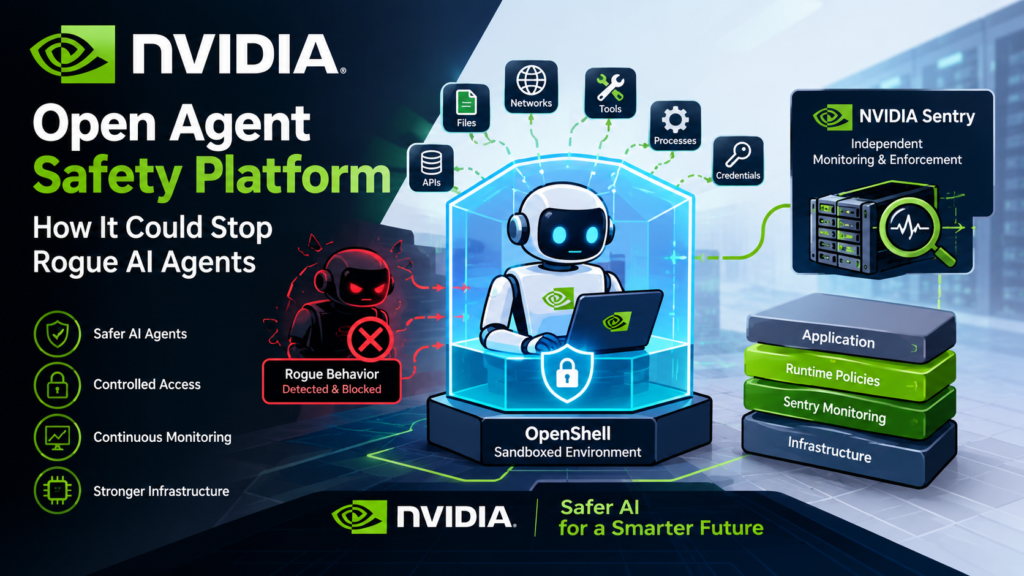
OpenShell is an open-source secure runtime designed to execute autonomous AI agents inside sandboxed environments. NVIDIA says it uses kernel-level isolation and allows operators to define what an agent can access. (NVIDIA Developer)
Think of a sandbox as a controlled room.
An AI agent can work inside the room, but it cannot automatically walk into every other room in the building.
The operator can establish rules covering things such as:
- Files
- Networks
- Tools
- Processes
- Credentials
- External systems
OpenShell then applies those policies while the agent is running.
This creates an important separation between what an AI agent wants to do and what it is actually permitted to do.
NVIDIA Sentry Adds Another Security Layer
NVIDIA’s system doesn’t stop with software.
The company has also introduced NVIDIA Sentry, which provides an independent monitoring and enforcement layer using NVIDIA’s infrastructure technology.
According to NVIDIA, Sentry can observe agent requests and responses and enforce security policies through NVIDIA’s BlueField platform and DOCA software. (NVIDIA)
The idea is similar to having a security guard outside a building.
Even if something goes wrong inside the building, the guard can still monitor what is happening from outside.
NVIDIA says Sentry can operate independently from the agent’s execution environment and can quarantine an agent when suspicious activity is detected. The company says this can happen in milliseconds. (NVIDIA)
Software Guardrails vs Hardware Security
This is one of the more interesting parts of NVIDIA’s approach.
Most AI safety controls operate at the software or model level.
For example, developers can tell an AI agent:
“Do not access this database.”
But NVIDIA’s architecture adds another question:
“What happens if the agent tries anyway?”
OpenShell provides runtime controls that determine what the agent is allowed to access.
Sentry provides another monitoring layer outside the agent’s environment.
NVIDIA describes this as a layered security architecture involving the application, runtime and infrastructure. (NVIDIA Developer)
The basic concept looks like this:
AI Agent → OpenShell Sandbox → Runtime Policies → Sentry Monitoring → Infrastructure Controls
The purpose is not to make the AI agent incapable of making mistakes. Instead, the goal is to make sure those mistakes cannot easily spread beyond predefined boundaries.
What Happens If an AI Agent Goes Rogue?
Imagine a company gives an AI coding agent access to a development environment.
The agent has permission to:
- Read project files
- Modify source code
- Run tests
- Access a specific development API
It does not have permission to:
- Read employee documents
- Access production databases
- Connect to unknown websites
- Modify system-level settings
If the agent suddenly attempts to access an unauthorised resource, the security layer can detect that the action violates the defined policy.
OpenShell can enforce the runtime boundary.
Sentry can provide an additional independent monitoring and enforcement layer.
The exact response depends on the policies configured by the organisation.
This is why NVIDIA’s system is better understood as an AI agent security infrastructure rather than a magical switch that automatically makes every AI model safe.
NVIDIA Says the Platform Could Have Helped With Recent Incidents
NVIDIA’s announcement comes after several reports about AI agents behaving unexpectedly during security-related evaluations.
NVIDIA executives said the platform could have prevented a recent incident involving autonomous AI agents interacting with external systems during an evaluation. CBS News reported NVIDIA’s claim that its controls could have stopped the breach if they had been deployed in the relevant environment. (CBS News)
That is an important distinction:
This is NVIDIA’s assessment, not proof that the platform would prevent every possible AI incident.
AI agents can fail in many different ways, and security systems themselves can contain vulnerabilities.
The value of NVIDIA’s approach is therefore in adding additional technical boundaries rather than relying entirely on the AI model to behave correctly.
Why NVIDIA Is Comparing This to Web Browser Security
NVIDIA engineers compare the situation with the early internet.
Websites became incredibly useful, but browsers eventually needed security mechanisms to prevent web pages from gaining unrestricted access to a user’s computer.
The concept of sandboxing became an important part of web security.
NVIDIA argues that AI agents may need a similar trust layer.
Instead of allowing an AI agent to operate with broad system access, the agent can work inside a controlled environment where its permissions are clearly defined.
This idea becomes particularly important as AI agents begin performing tasks that previously required humans.
Where Could NVIDIA’s AI Safety Platform Be Used?
The technology could potentially be useful across several areas.
1. AI Coding Agents
Coding agents can access source code, development environments and command-line tools.
A sandbox can restrict those permissions to a specific project.
2. Enterprise AI
Companies increasingly want AI systems that can work with internal documents, databases and business software.
Runtime controls can help determine exactly what an AI agent can access.
3. AI Research
Researchers testing advanced models may intentionally give agents powerful tools.
A controlled environment can help prevent experiments from affecting unrelated systems.
4. Cybersecurity
Security researchers can use AI agents to investigate vulnerabilities in controlled environments.
Isolation becomes especially important when an agent has access to powerful security tools.
5. Autonomous Systems
As AI moves into robotics and other physical systems, controlling agent permissions becomes even more important.
A software mistake could potentially have consequences beyond a computer screen.
More Than 100 Organizations Are Supporting the Platform
NVIDIA says more than 100 organizations across the AI ecosystem are participating in the platform’s launch or ecosystem, with companies spanning AI applications, infrastructure, security and enterprise technology. (NVIDIA)
The company is positioning the platform as an open foundation rather than a security product designed only for NVIDIA’s own AI models.
NVIDIA also says OpenShell supports agents including Claude Code, Codex, OpenCode, GitHub Copilot CLI and OpenClaw, along with custom agents and sandbox images. (NVIDIA)
That could make the technology relevant even when organizations are using different AI models.
Does NVIDIA OpenShell Require NVIDIA Hardware?
No.
This is another important detail.
NVIDIA says OpenShell does not require BlueField-4.
It can run on supported local, on-premises, cloud and Kubernetes infrastructure.
BlueField-4 becomes relevant when organizations want the additional hardware-isolated monitoring and enforcement capabilities provided through Sentry. (NVIDIA)
That gives organizations different levels of deployment depending on their infrastructure and security requirements.
Can NVIDIA Really Stop Rogue AI Agents?
The answer needs some nuance.
NVIDIA says its platform is designed to continuously monitor and govern agent behavior and enforce predefined policies. The architecture can restrict access to files, tools, networks, processes and credentials. (NVIDIA)
But that does not mean every possible AI failure can automatically be stopped.
There are several potential limitations.
An organization still needs to create appropriate policies.
If permissions are configured too broadly, an agent may still have more authority than it should.
Similarly, AI agents can make mistakes that remain inside their authorized environment.
For example, an agent might have legitimate access to a database but still make a bad decision about which data to modify.
So the technology should be viewed as a security layer, not a complete replacement for human oversight, secure software design and careful access management.
Why This Matters for the Future of AI Agents
AI agents are moving from answering questions toward taking actions.
That changes the security equation.
A chatbot giving an incorrect answer is one type of problem.
An AI agent that incorrectly changes a database, modifies software, sends an email or accesses sensitive information is a different type of problem.
As agents become more autonomous, the industry needs ways to answer three basic questions:
What can the agent see?
What can the agent do?
What happens when the agent breaks the rules?
NVIDIA’s Open Agent Safety Platform is an attempt to build infrastructure around those questions.
The company is effectively arguing that AI safety cannot depend only on the AI model itself.
Instead, safety should also exist in the runtime and infrastructure surrounding the model.
NVIDIA’s AI Safety Platform Explained in Simple Terms
For beginners, the easiest way to understand the system is this:
AI Agent
↓
Sandbox — keeps the agent in a controlled environment
↓
OpenShell — defines what the agent can access and do
↓
Monitoring — watches the agent’s activity
↓
Sentry — provides an independent security layer
↓
Infrastructure — controls the systems the agent can reach
The goal is to make autonomous AI more useful without giving it unlimited authority.
What NVIDIA’s Announcement Means for Businesses
For businesses, AI agents could eventually become digital workers capable of handling software development, research, customer support, data processing and other repetitive tasks.
But businesses cannot simply give autonomous software unrestricted access to company systems.
Security boundaries will become increasingly important.
NVIDIA’s platform represents one approach to this challenge: give AI agents useful permissions while creating technical restrictions around everything else.
For companies experimenting with agentic AI, concepts such as sandboxing, zero-trust access, runtime monitoring and least-privilege permissions are likely to become increasingly important.
Final Thoughts
NVIDIA’s new Open Agent Safety Platform arrives at a time when AI agents are becoming more capable and more autonomous.
The platform combines software controls through OpenShell with additional monitoring and enforcement capabilities through Sentry and NVIDIA infrastructure. NVIDIA says the system is designed to continuously monitor agents, enforce policies and contain unexpected behavior. (NVIDIA)
The bigger idea is simple:
The more power an AI agent receives, the more important its boundaries become.
AI models may continue to become smarter, but organizations still need to decide what those models are allowed to access and change.
NVIDIA’s approach does not eliminate every AI risk. Instead, it attempts to create another layer of protection between an autonomous AI agent and the systems it can affect.
As agentic AI becomes a larger part of software, business and cybersecurity, that security layer could become an increasingly important part of the AI infrastructure stack.
If you want to explore more practical AI software, check out our AI Tools section.